The
Nasca Monkey
Americas'
Golden Mean Champion
Introduction
Secrets of the Pentagon &
Nasca
Every picture tells a story. The figure of a nine-fingered
monkey from the desert near Nasca, Peru tells its story in a
symbolic language, and contains much more than meets the eye.
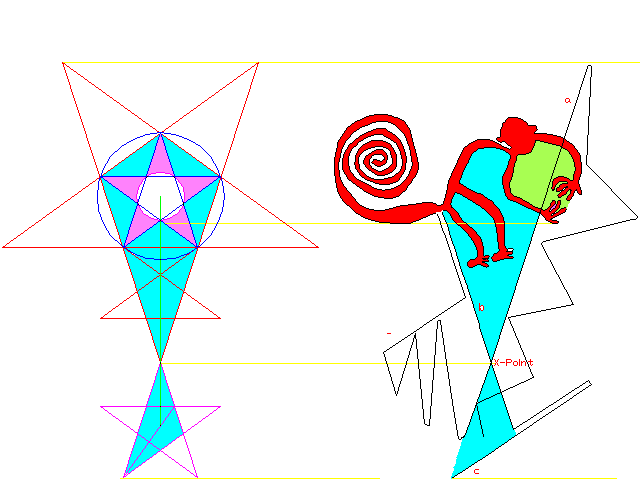
How much of
the figure on the left can be found in the Nasca figure on
the right? (Hint - a lot). This report shows
prehistoric artists engaged in a game of logic and
encryption, utilizing a scientific code derived from
geometry. The design of the Nasca Monkey is as deceptively
simple, as it is sophisticated. Its clearest objective seems
to be self-affirmation, as logically coded art. Naturally,
such coded art turns prehistory upside down.
The monkey
was designed over a pentagonal structure. /see
note
In this, the monkey takes over the second oldest spot in a fascinating
category - Golden Section in art and architecture. In this world,
many old, as well as modern masterpieces also have hermetic
structures basing on Golden Section. There is a belief that the
presence of Golden Section (Φ) enhances perfection and beauty
in human perception. The Golden Section compasses surviving
in museums, which had once been popular with Renaissance
artists, serve as indisputable physical evidence of this trend.
Hermetic art structures can be exposed by a
variety of rational methods. However, prior to my experiments, no one had kept an open eye for mathematical
sophistication in Stone Age materials.
Therefore, I sure am glad
that my analysis is easily verifiable.
One
Discovery Leads to Another
The hard, but brittle dark-red
crust of pebbles sunbaked with mud on
the desert surrounding the town of Nasca, Peru (Nazca in English) is
thousands of years old. The crust crumbles easily under feet of
bigger creatures, not to speak of terrain vehicles. When exposed, the
fresh soil below the crust is of a bright ochre color, which contrasts
vividly with the dark-red patina on the aged surface. Before history
began to be recorded in this area, someone had exploited this contrast
to decorate vast tracts of this desert with a majestic and puzzling
collection of straight lines from horizon to horizon, and beyond,
spirals, large trapezoidal clearings, and various giant animal and
plant figures. Modern ad-industry got into the act around Nazca, as
well. Using the same ancient method, it vies for the attention of
air-travelers by giant signs marring the natural museum in the worst
taste of invasive in your-face commercialism, while simultaneously
providing a perfect example of how such giant figures are meant to be
seen from high above by be it airline passengers, astronauts,
flying saucerites, or gods, deities, and spirits. The largest
clearings at Nasca can be espied by unaided eye from low planetary
orbits, while at the vision-limits on the other side of the Andes,
there lurks the archeological super-site of Machu Picchu. Numerous
speculative theories have been advanced on Nasca, all of them wrong.
Most information on Nasca comes the prolific fieldwork of Maria Reiche,
a math teacher in her native Germany, before becoming Nazca's guardian
angel. Reiche had devoted her life-time to surveying and protecting of
the Nasca markings. This intrepid vegetarian lady had lived like a
bedouin while patiently dusting off the desert with a broom to revive
the faded figures, measuring, sketching, etc. If not for Reiche -
the figures wouldn't have had survived irrigation plans for ranches in
the area! Luckily, Reiche managed to win Peruvians over to the
conservationist side. Ave Maria ...
The consensus has it that the line makers had to be good at
land surveying techniques to implement the designs, which
the eye cannot span from the ground level. Yet, the
consensus stops well short of
wanting to imply that the
line makers had advanced science - a notion, which would
require rewriting of history. The consensus presumes that
the Nazcans had a relatively advanced method of scaling
designs onto the pampa. The designs themselves are not
suspected of mathematical sophistication. In contrast,
Reiche became convinced that the lines hold ingeniously
encoded information. Promptly, she spent a lot of time
trying to break the code. As one possibility, Reiche had
considered the "sacred path" idea, which
likens the lines to the still unsolved "knotted cords",
once used by the Incan civilization as a way of keeping
records. The Nazca lines were perenially short of a good
theory. For instance, searching for connections between the
markings and astronomy never turned up anything worthwhile. True, most such
searches had concentrated on skies of the early first
millennium A.D., to which researchers credit the markings'
genesis. No one had checked dates like 10,500 BC, etc.
Critics complain that Reiche failed to document any of her
ideas (on the geometrical skills of the Ancients) in a
sufficiently convincing< manner, having published just
too little material. Yet, the critics did nothing for
the advancement of Nazca's research, unlike Reiche. While her documentation may not be convincing,
it certainly is enticing. Regarding the credibility of my own report, at least some of my observations must merit
automatic attention. Let me just mention the matter of
the Monkey's positioning to the world compass. Surely, such
a matter can and should be considered in all objectivity.
But, when shall this pass?
The
Phi-ratio, or the "Section", as the Pythagoreans called it, occurs on
only one regular figure - the five-pointed star. Pythagoreans guarded
their knowledge of the star's secrets, having sworn to seek and destroy
all those who would betray them. This must have been the traditional
approach to the matter by high priests of the Egyptian Temple.
Pythagoras was once one of the highest priests in Egypt.There was no
gain in protecting these secrets, so, perhaps, these were
considered dangerous somehow. But, how could Mathematics be
considered dangerous? The idea might not be so strange, if Science
has been misused before. There is no shortage of myth on Wars between
Gods. But ancient authors also speak of the Secret of Life. In my
interpretation of his passage on the solids, Plato claims that the
Dodecahedron - the 3-D solid with twelve faces of either a five pointed
star, or a pentagon - holds the Secret of Life, as this was the
Divine Design with which God had animated the Heavens, i.e., the
Universe. Translators have two options for the word Plato had
used:
a) to
draw figures of beings
b) to
animate with soul
They opt for version 'a)'
without hesitation and then muse at the impenetrable meaning of their
own words "Dodecahedron, with which God had decorated
the Heavens". Why not choose veersion b 'Dodecahedron,
which God had used in the Creation of Life.'
We
do see all around countless simpler forms of Life like
flowers, or sea-stars, proving Life's pragmatical use
of the Golden Mean and other secrets of the 5-pointed star.
Does this not make the star magical?
|