|
The
Seal of Atlantis
The Cone &
Square formation
:

|
The mystery of the Cone
The K-circle takes part in the
balanced layout of
Athena from head to
toe, as we just saw. Here, the K-circle forms
the
Cone with two more circles .
1) The centers of the K-circle and of the
two new circles
lay on one line.
2) In addition, the three circles are symmetrical (have
common external tangents).
The external tangents, which
demonstrate that the three circles are symmetrical, and the circles
form the Cone.
The
Cone's middle circle
Unlike the K-circle, the other two Cone
circles reappear throughout the engraving. For instance, the
arcs
on Athena's
right leg (which we
saw imply an equilateral
triangle) have the same radius as
the Cone's
middle circle.
How can I say so? After all, due to circumstances, when a given arc
indicates a circle, that circle is not sharply defined, but
rather
it has a narrow range of possibilities, which all look just about as
good, as they all seem to follow the arc.
How do we determine, what circle best fits a given arc?
Such a circle should fit nicely not only the arc, but also the
picture:
Is the circle's center signalled by a marked point in the
engraving?
Or, does it sit on a line's edge?
Is the circle propped against other lines, and line ends?
Does it consistently pass through points like line crossings?
Does it seem to be of the same size as a group of other circles? _If
so, this should be the right circle, because it looks deliberate in all
aspects.
So, there I was - crazy enough to draw regular geometrical figures
over a 14,000 years old engraving. I had the Square, and the Cone, and
the fact that some circles were reiterated in a number of
places.
Were they standard?
* |

.
The Cone cannot be solved without the
next clue:
The Cone
duplicates the angle at
the tip of a 5-pointed star.
So, was the Cone drawn from a 5-pointed
star?
At this stage, I started to seriously search for a
5-pointed
star, which would explain the specifics of this Cone.
|
|
|
The Big Breakthrough
Quite
a few arcs in the
engraving of Athena translate
into circles just like the Cone's middle circle.
Based on this frequency of appearance, the Cone's middle circle could
conceivably be a unit circle. Therefore, measuring the Cone with it is
natural, and that's what I did.
(diag.below).
step
by step procedure:
I drew five unit circles spaced by the radius along each arm of the
Cone.
Then I drew the same circle from the center of the K-circle. It was
a perfect tangent to
the two nearest unit circles on the Cone, thus capping the
Cone.
Cone Mapping.diag
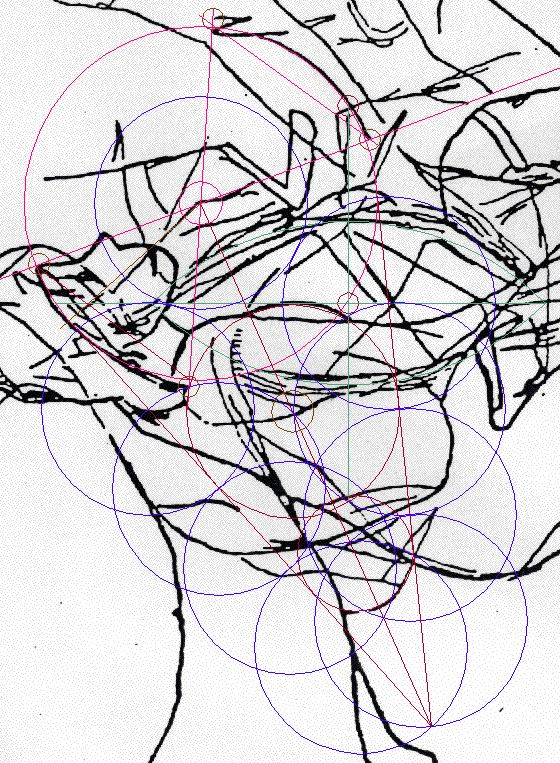
Since measuring out 5 unit-circle radii
along the
Cone's sides is is the key part to
its solution, does this indicate
that the hypothetical star to be
imposed upon the 36 degree Cone should have
arms 5 unit-unit circle radii long?

|
Problems
of perception
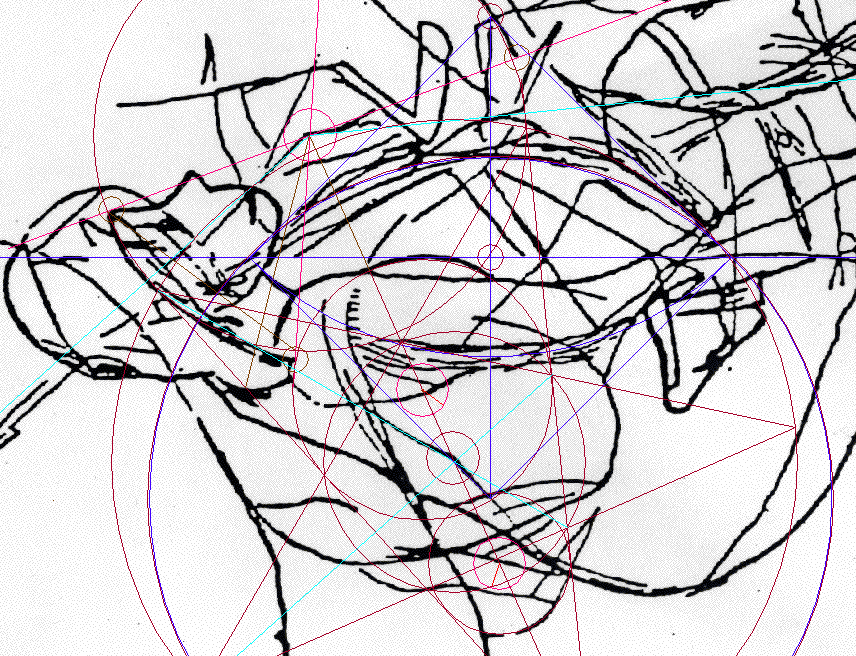
The new Cone-star (S-star)
creates some
special visual effects.
Drawing the circumcircle of the Cone-star concentrically with one
of the Torso circles, shows that the two radii differ by one pixel
only.
(diag. above) The Cone's circumcircle also seems to be a perfect
tangent to one side (north-east) of
the Main Square.
At the time of the experiment, I was quite perplexed by this. Did the construction of the Square from
the Cone exactly duplicate the
Cone's circumcircle on the
Torso?
Note that when drafting by
hand,
a
similar question arises with the so called Circle-Triplets, shown
in
the diagram below. All three seem close to being identical in
size.
But, are they identical? _ My curiosity went unsatisfied until I could
recreate the position in CAD, on a $2,000, 10 MHz pc :)
The
Circle-Triplets
Take a circle, which passes
through the
inside points (corners) of
our 5-pointed star.This circle (dubbed Inner-circle) on our
experimental Cone-star seems to
be just as big as Unit-circle, but also just as big as the
Middle-circle of the Cone.
On paper, the radii of both the inner and the middle circles fit the
Cone-star's arm a near
perfect
five-times, once a hair short - and once a hair too long.

In the diagram above, the
three CAD produced
Triplet circles were made concentric, and then highly magnified. Yet,
despite their magnification, these three circles
look like a single circle. But, the following is true:
If the Unit circle's radius = [1]
then the Inner
circle's radius = [1.0040..]
radius of the Middle-circle = [0.9975..]
One mathematical
consequence of this unit
system:
The side of a pentagon inscribed into the 'inner'-circle measures
1.1180339887...
- the
square root of 5
divided by
2
The PHI-ratio
equals the same square
root of 5 divided by 2 +
0.5
1.11 80339887... + 0.5 = 1.6180339887..
Now, measuring of the Cone
by the
unit-circles makes perfectly good
sense.
|
|

The
unit circles
describe
the Cone perfectly.
The experiment was a big success. Now, when we view the the Cone, as it
is logically described by the unit circles, we actually see its
geometrical solution, as well.
And, when we review this solution together with the Square,
we
realize that this solution solves its origin (construction) too!
Reverse of the Cone mapping
procedure
We used the Cone for the mapping process. The logic behind the results
of the mapping makes it possible to reverse the process. Starting from
scratch, we can reproduce the mapped cone, and then use it to get an
exact facsimile of the original Cone

The size
and position of the K-circle on the Cone
The
K-circle was generated
from the capping
circle's center as a
tangent to the Cone's sides.
But, this center-point may be found by
an even quicker method - the upper intersection of the third row
of
the mapping circles on the central axis marks the mid-point between the
K-circle's center, and the tip of the Cone.
The size
and position of the Middle-circle on the Cone
It is also derived from the unit circles describing the Cone: the
fourth row of
these circles (whose centers are 3 radii from the tip of the Cone)
intersects at the center of the Middle circle (diag. below).

The size
and position of the
Small-circle on the
Cone
It is meant to fit
between:
a) the internal tangents
b) the external tangents (Cone's sides).
*
It is logical to reason that the
Cone and its
circles are derived from a regular 5-pointed star
(the Mother
Star).
The size
and position of the Square
with respect to the Cone
The self-explanatory Cone also explains
the Square's construction.
The Square - derives from the Cone in a process requiring
just three circles: the K-circle, and two of the mapping Unit-circles.
Procedure:
The Square's horizontal
diagonal rests
upon two of the unit circles.

<>The K-circle intersects the center of the
Square on
the horizontal
diagonal, which we already have. From there, we then draw the vertical
diagonal of the Square. The higher point, at which the K-circle crosses
the vertical diagonal,
marks the Square's top
corner.
|
The
Cone, the Mother-star
& Geometry
The Cone's concept turns out
utterly methodical,
and scientific. Neither Euclid nor Pyrthagoras could improve upon it.
Our
caveman thinks,
as if he were a professor of mathematics.
I had come across some diagrams
looking like the
Cone, in a collegiate handbook on geometry. The diagrams dealt with the
topic of similarity
of
circles: That's when I learned that theory calls the Cone's sides "common external tangents - and
the Cone's tip
the "external center of similitude.
Next, the book revealed that there are internal counterparts to these:
1) the Internal
Tangents between the Cone's
top, and small circles.
2) the Internal Center of Similitude,
at the point S.
|

| Click for animated
construction of the tangents
(26 Kb)
In
the illustration above, we use parallel
diameters of two
circles to find their centers of similitude, or symmetry:
A line between opposed ends of the diameters intersects
the line of circle-centers at the internal center of symmetry "S"
_ An internal tangent is drawn from S to both circles.
A line
between the correspondent ends of the diameters
intersects the line of circle-centers at the external center of
symmetry "V". An external tangent is drawn from V.
The
Ancients had indicated their knowledge of external
tangent construction by symbolizing the Cone. But, could
they have indicated their knowledge of the complementary
internal tangent construction?
Well,
our own construction of internal tangents between
the Cone's top and bottom circles results in a
spectacular
effect..
|

| A Rare Illusion - Six
lines fuse to look like a single line
In this
situation, the four numbered points produce
six different lines.
However, all these straight lines give an illusion of being one and the
same line (see diag. above). The effect is as beautiful, as it
is unlikely. The indication is that the Ancients knew, and
played with, the idea of internal tangents.
Now,
the Cone's external center of symmetry sets
one tip of its star.
To be consistent, the Ancients should have used the Cone's
internal
center
of symmetry for the center of its 5-pointed star. - This would
explain the
smallest circle of the three on the Cone, as wedged between
the
internal and external tangents. The internal tangent was first drawn
as a tangent to the K-circle from the 5-pointed star's center, then it
was extended,
and then the small circle was drawn.
Go to
animation on the
Triplets
|
|
© Jiri Mruzek (to write me, use
Yahoo.com + my name without the space)
Discussion Forum
You can use a fake e-mail to log
in
|
