|
There are many
signs worldwide that there was once an advanced
civilisation that had long ago perished in some
cataclysmic disaster. Material objects big and
small, such as the Great Pyramid or fragile schist
vases seem impossible to make without advanced
technology. The notion finds strong support in
many olden stories describing the use of
technology sometimes surpassing what we have today, but the
origin of those stories is attributed to their
tellers unbound imagination.
Apparently, there is a lack of tangible proof,
such as prehistoric power tools or scientific
literature; and so it is understandable that the
academy overwhelmingly accepts a basically
linear version of world history with no room for
advanced prehistoric technology, be it Atlantis
or Ancient Astronauts.
But the present paradigm would have to change if
it were to account for a discovery I count
myself incredibly lucky to have made. It is very
difficult to sum up here in a brief introduction
because there are so many ways to do it that
one doesn’t know where to start.
Advanced prehistoric technology really did exist. That means that there
also was some society somewhere using that technology. As if it
knew that its very existence will be in doubt in the future, the
decision was taken to create lasting documentation capable of
dispelling such doubt. That the truth be given a chance to prevail at
some unspecified but critical moment in the future was obviously
deemed important. But, by the same token, a different outcome — the
truth remaining hidden — was also given a fair chance.
The actual
proof I
found so far comes encoded in three parts. Each
part is a stand-alone
module which then adds up with the other two to a much greater coherent narrative — a trilogy — a majestic scientific enterprise constituting an unassailable proof of
the existence of
advanced prehistoric science.To show that this society, or agency, was in global control of
the Earth, the modules
were distributed among South America, Europe and
Africa. To suggest its
stability and longevity, it had spread
the evidence over the
span of at least 12,000 years, if we are to
trust our current dating of
these artifacts. If so, this would imply that
this once prehistoric
agency was immune to any intervening catastrophes and may still exist parallely with our society.
Part 1 - Athena
Engraving - the World's Most Important
Picture
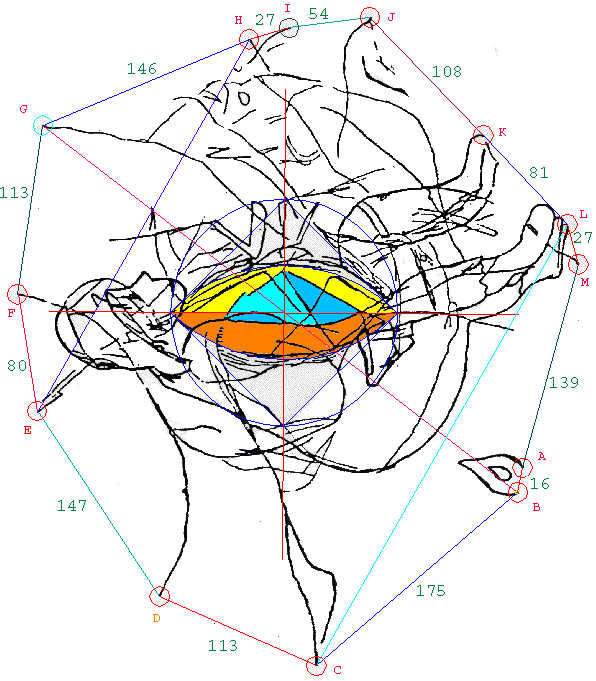
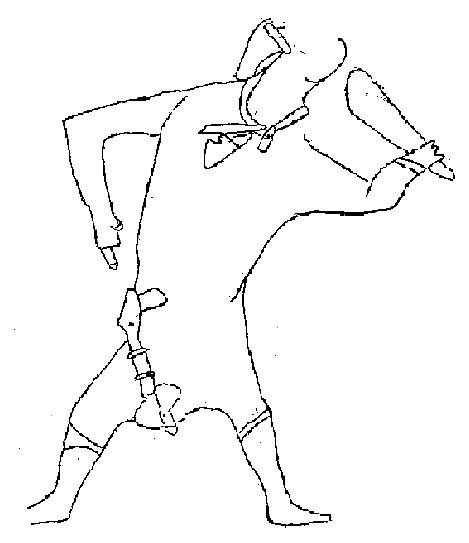
The discovery began with this Stone-Age engraving
shown below. Despite appearances, it is not a
free-hand drawing.. It
is a direct standalone proof
of profound knowledge of Mathematics,
brilliantly encoded into Art more than 14,000
years ago. It is by
far most formidable among
the
three components of the trilogy due to its complexity. Constructed from exact ideas
with stunning
accuracy, its complexity is so great that AI
(artificial intelligence)
is not out of question. It's either that or a
super-intellect at
work.

The
engraving's naive appearance camouflages a
masterpiece of cryptographic
Science-Art with heavy presence of Phi, the
Golden Section, also known
as the Divine Proportion. And so the young lady
from the engraving
fully deserves to be the namesake of goddess
Athena. The engraving then
is the Athena
Engraving.
Just moments after I had first
seen the image, I
felt something in it whispering mysteriously at
the thresholds of my
perception. The
art was so
ancient, yet sophisticated; a portal into an adventure in a whole new world.
Eventually, my philosophical approach to
art analysis had struck the vein
of advanced prehistoric mathematics.
Familiarity with the engraving's basic
geometry, had positioned my efforts for an
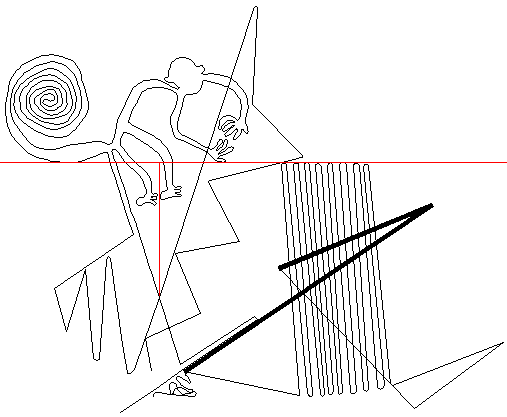
unexpected windfall _ the solution to "Nazca
Monkey", the giant glyph of a monkey from the
Nazca Lines, Peru. It became a low-hanging fruit,
since it openly showcases the same (basic)
geometry.
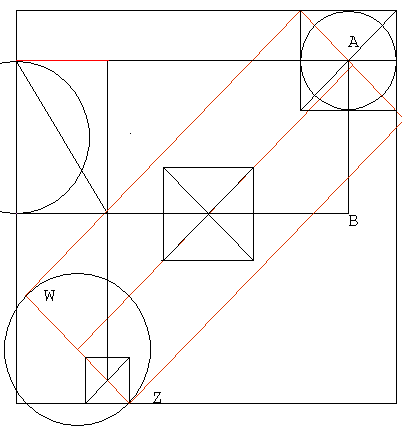
Indeed, both Science-Art works stem from
the same exact construction _ a shared template, I dubbed poetically the Seal of Atlantis. The
odds against such replication by accident are cosmic; therefore, Athena and the monkey must both be authored by one and the same agency (onwards - the Agency). Moreover, it is most likely that the conclusion extrapolates to the La Marche engravings and Nazca Lines in their entirety.
At that stage, my research results had acquired a unique status. They
transcended being just more evidence and became an actual proof of
advanced prehistoric science. With any 'mere' evidence, no matter how
strong, there is always a chance that a different interpretation of it
may yet be found. Proof is proof because it eliminates any possibility
of finding another rational explanation for the evidence on hand.
This is the only case I know of in which we are able to methodically abstract bona fide coherent voluminous scientific thought from prehistoric media - encoded time capsules.
The discovery took on a new dimension when it turned out that the ground plan of the three great pyramids of Giza is incorporated in the Athena Engraving, where it plays a prominent role . Clearly, this development brings far reaching implications.
Years go by and the
proof of prehistoric science I have made available is staying under the
radar (summer 85 to June 23). Though facing exposure throughout that
time to all kinds of gaslighting, and outright disapproval -- my
confidence in the discovery's genuineness has only grown every time it
added depth and scope. After all, I'm the one most familiar with
it; I know that I stuck with a methodical, rigorous approach; I
was there for those magical 'heureka' moments, when the unexpected
turned out real. So, yeah, I know..
Of course, I must accept some portion of blame for not breaking through, but I
also see some external factors standing in the way -- cognitive
dissonance in preconditioned, socially managed public, plus the
expectable resistance by interests threatened by the proof. For instance, my
website had been blacklisted by Google's Safe Browsing Directory over a
week ago. It was singled out from all those websites devoted to ancient
mysteries, etc; so I take it as a sign that, at least in the eyes of
some, my work is special, and suppression-worthy.
June 6. 2023_
Several days ago. Google's Safe Browsing Advisory. which
everything on the Internet seems to heed, began openly suppressing this
website [i] Imagine my surprise when going to one of my pages on my
favorite browser, up came an all red screen saying Deceptive
site ahead Firefox blocked this page because it may trick you
into doing something dangerous like installing software or revealing
personal information like passwords or credit cards.
Of course, the accusation is totally false! Shame on you Google..
On the other hand, this
act by Google may turn out to be blessing in disguise. People will
wonder why Google all of a sudden does something so unprecedented as
attacking a site entirely devoted to analysis of ancient art and
artifacts for presence of mathematical design, After all, there are
great many other sites devoted to the same subject: and no one ever
tries to suppress them. What's going on? Who is afraid of what I
discovered? Google's sinister AI brain? That would be ridiculous!
Sure, my site may trick the reader into "doing something dangerous" like believing in the existence of advanced prehistoric science & technology.
Google should act more responsibly; it should check out all accusations
before acting on them. In this particular case, Google will eventually
have to admit its wrongdoing.
June 21st, 2023: Just like that, Google stopped
its blacklisting of my site. A letter of apology and an explanation
would be appreciated, as well. What the hell was it all about?
*
About the third part of the trilogy, the Giza
ground plan solution, I
would have never dared to tackle the problem since I knew
that many great minds
have been occupied with the Giza pyramids for
centuries, and so I'd
just be wasting time trying to contribute
something new. But, my
interest was sparked by a couple of successful
(IMHO) forays into
related problems, I had made.
First, the internet controversy over the so
called Abydos
Helicopter from the Abydos temple of Seti I
and Ramses II caught
my attention, and I thought that a geometric
analysis was in order. It then indicated that
these glyphs do not
constitute a so called palimpsest, but instead,
they
are constructs of an exact nature at whose
birth had stood the
Golden Section. That gives credit to the
idea the anomalous
glyphs had been engraved essentially as we see
them today, contrary to orthodox Egyptology.
The "Abydos Helicopter
& the Golden Section"
study provides compelling reasons why the
official archaeological
explanation _ the Palimpsest theory_ is plain
wrong. For years it
used to garner the attention of a steady stream
of readers, on a couple
of blue moons peaking in thousands of hits per
day, until
Google changed its algorithms. Instead of being
in the top several
search results, it is now pages and pages back,
most likely labeled
as pseudoscience.
*

©Bruce Rawles background
photographed in November1992
If
this were modern art, we'd have no doubt that it
clearly shows a
helicopter next to a stacked formation of three
harder to identify
advanced craft (a boat, a hovercraft, a tank, an
aerodynamic plane or a
zeppelin, etc). Disavowal stems strictly from
the fact that this
art is over 3,000 years old, and we know that
there was no advanced
technology and science in our misty past - don't
we?
The scene had caused some sensation in the
nineties, but soon
Egyptologists claimed to have identified at
least two sets of overlapping hieroglyphics in it.
This proffered a simple scientific
explanation: What we see is a palimpsest, i.e., an accidental illusion. First there
had been some original glyphs, which were later
hidden by plaster, and replaced by a set of
different glyphs engraved partially in stone and
partially in the plaster. Eventually, the
plaster had crumbled out, and the overlapping
hieroglyphs began looking like images of modern
craft.. With this simple explanation, science had
prevailed over sensationalism, it would seem.
The present scientific consensus depends
on the assumption of Chaos as the creative
force behind the Abydos Helicopter scene. To
thwart the consensus, and to disprove the Chaotic
explanation, it must be shown that
the glyphs obey a clear rational
order. Simple
testing does indeed lead to such
a conclusion : The Abydos Helicopter
scene is not a palimpsest, it is a design.
The other foray resulted in ”Are the World's Biggest
Building Blocks Prehistoric?”
The article cites
multiple reasons why the famous Baalbek
Trilithon wasn't built by Romans but rather much
earlier, in prehistory. Even today, Rome is
generally credited with moving the Trilithon
blocks from the quarry some 900 meters distant
to the site of Baalbek's Jupiter’s
temple. I was able
to dig up historical facts indicating that
Romans could transport only stone blocks
weighing no more than about 325 tons. So, the
Trilithon blocks had to be moved in much earlier
times and by technology superior to that of
Rome. Forget putting the Trilithon blocks on
wooden sledges and moving them over uneven and
unpaved terrain _ despite the availability of
capstan technology.
The modus
operandi of the so called skeptics now maintains
that there is no need for advanced technology to
move blocks exceeding 1,000 metric tons in
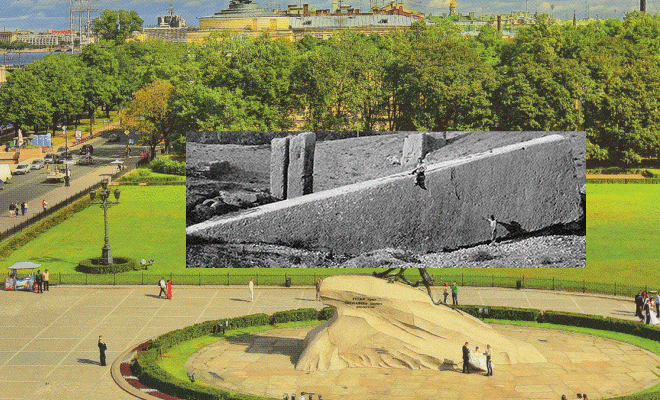
weight since the Russians had moved the 1,500
ton stone block named the “Thunder Stone” (Grom
Kamen) to St Petersburg from a remote location
without the use of modern technology. I checked
the story out and found it deceptive.
The Thunder Stone - From 1,500
tons down to 400

Unlike
Russians in the second half of the 18th
century, Romans and their predecessors
supposedly had no ball-bearings (cannon balls), steel rails,
and metal sledges. Those things are
all benefits of technology. One has to
admire Falconet's engineering achievement; what
he had proven was that technology of
the late 18th century was capable of
transporting large megaliths.
Given the right conditions, this technology
could probably move even much larger and heavier
objects. Just scale everything up; use more
steel tracks to distribute the weight, and put
colossal objects on very large steel platforms
riding on a great number of very large steel
wheels. Hook it up to a system of capstans and
pulleys for mechanical advantage, and then,
using just our human power "alone", a small mob, or a herd of elephants,
could definitely move the whole thing along.
After all, it's documented that a single
strongman can pull a Boeing 747, under the right conditions...
*
Eventually I confronted another controversy
regarding ancient Egypt - Was there a common
ground plan for the three great Giza pyramids?
To my surprise, I was able to document
that the ground plan, as surveyed by
Petrie, can be derived from a specific version
of constructing the regular five-pointed star.
It was an astonishing development; the same
method is heavily featured in the Athena
Engraving, and it is the high point of the
Nazca Monkey design!
The Exact Reconstruction of the
Layout of the Great Giza Pyramids
can be objectively weighed against the rest of
the field. In other
cases my research ran a one-horse race;
here, it ventured into a
problem, which has been worked on by many ever
since 1883. I believe
that my solution is a front runner. For one, it
cannot be outdone in
accuracy. What's more, it passes with flying
colors the rigorous test
of being projected onto the Athena Engraving to
see if there is
significant harmony between the two. The
test is possible because
both works originate from the same construction
of the five-pointed
star. They are united by making their stars
selfsame.
The rock shelter of La
Marche near Lussac-les-Chateaux, southern
France - a
Stone-Age Academy?
|